How Fault Is Determined In A Multi-Car Pileup
Most people picture a car accident as something that happens between two vehicles. One driver runs a red light, another gets rear-ended. It is messy, but at least it is contained. Multi-car pileups are something else entirely.
Author:K. N.Mar 24, 202628.3K Shares481.1K Views
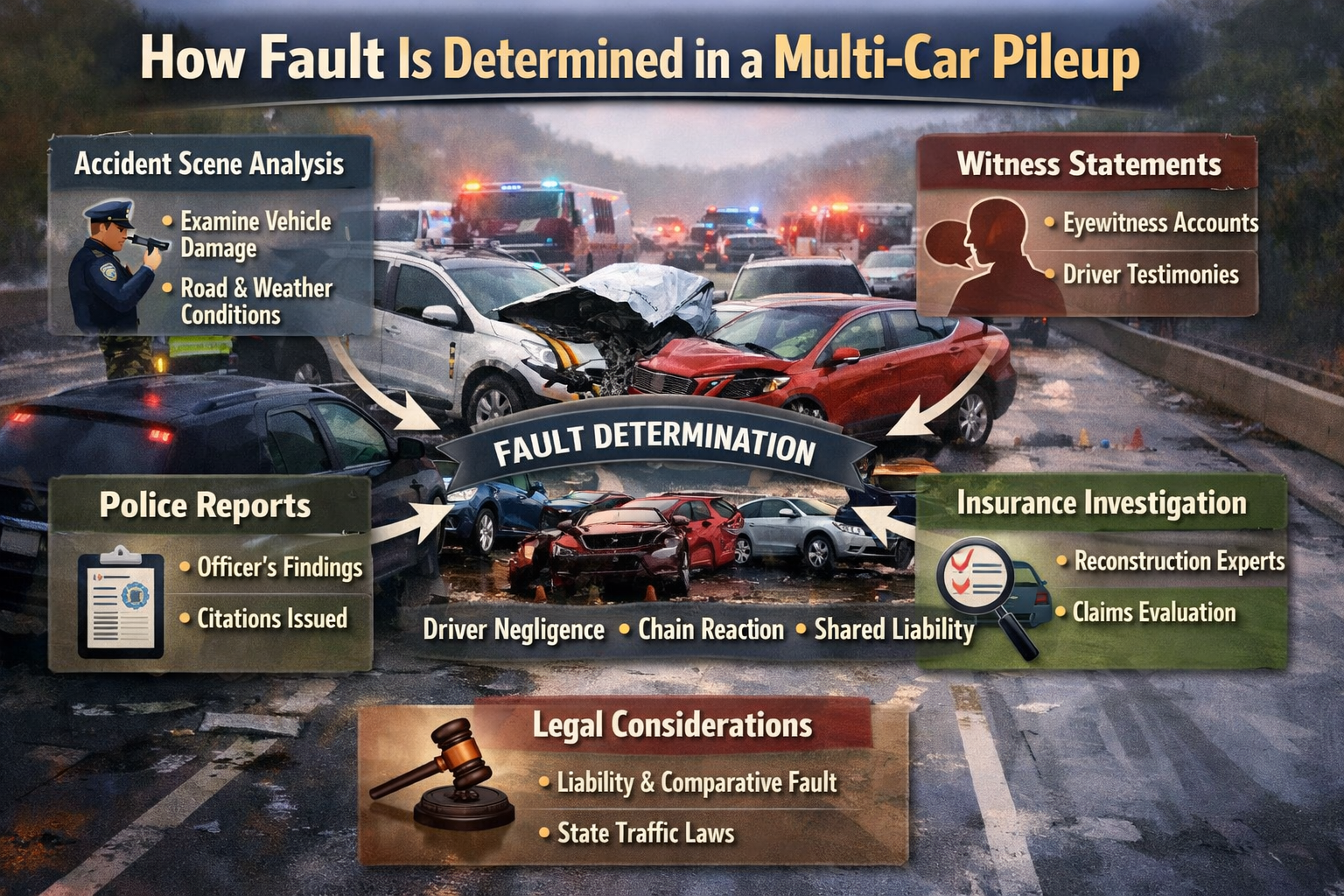
Most people picture a car accident as something that happens between two vehicles. One driver runs a red light, another gets rear-ended. It is messy, but at least it is contained. Multi-car pileups are something else entirely.
When three, five, or ten vehicles pile into each other on a wet freeway or a foggy stretch of highway, everything gets complicated fast. Who hit who first? Was the driver in the middle actually at fault, or were they just caught between two bad decisions? According to the National Highway Traffic Safety Administration, more than 38,000 people die in motor vehicle crashes each year in the United States. Multi-vehicle collisions make up a significant and often underreported share of those numbers.
If you have been involved in a chain-reaction crash, understanding how fault gets sorted out is not just useful background information. It directly affects whether you walk away with fair compensation or get stuck holding the bill for someone else's negligence.
Why Multi-Car Accidents Are So Much Harder To Untangle
Think about what actually happens in a chain-reaction crash. Driver A brakes suddenly. Driver B, who was following a little too close, hits Driver A. Driver C, who was looking at their phone, hits Driver B. And depending on road conditions, the pile keeps growing.
Now there are three drivers, three insurance companies, three different versions of the story, and three separate liability investigations all running at the same time. The Insurance Information Institutereports that rear-end collisions alone account for nearly 29% of all vehicle crashes in the U.S. A lot of those turn into multi-car pileups when traffic is heavy or visibility is poor.
The most common triggers for chain-reaction accidents include:
- Sudden braking with no warning
- Distracted driving, especially phone use
- Speeding in heavy traffic or bad weather
- Tailgating and unsafe following distances
- Rain, fog, ice, or other visibility-reducing conditions
- Impaired driving
What makes these cases legally complex is not just the number of vehicles. It is that multiple drivers may each have done something wrong, and untangling exactly how much each person contributed to the crash is where things get contentious. Every insurer involved has an incentive to push as much blame as possible onto someone else's policyholder.
How Does Comparative Fault Work In Texas Car Accidents?
Texas uses a system called modified comparative fault, and it has a rule that matters a lot in multi-car accident cases: the 51% bar.
Here is what that means in plain terms:
- Fault can be spread across multiple drivers, with each assigned a percentage.
- If you are found partially at fault, your compensation gets reduced by that percentage.
- If you are found more than 50% at fault, you cannot recover anything at all.
So if your damages total $80,000 and you are found 25% at fault, you can recover $60,000. But if investigators or a jury decides you were 51% responsible, you get nothing, even if another driver was clearly negligent.
In a multi-car pileup, this system plays out across every party involved. Each driver gets assigned their share, and the math determines who owes what to whom. Here is a simplified example of how that might look:
Texas Comparative Fault: Sample Breakdown
Driver A
- What Happened: Rear-ended Driver B at speed
- % Fault: 40%
- Texas Outcome: Can recover (under 51%)
Driver B
- What Happened: Stopped suddenly without warning
- % Fault: 35%
- Texas Outcome: Can recover (under 51%)
Driver C
- What Happened: Distracted, hit Driver B
- % Fault: 25%
- Texas Outcome: Can recover (under 51%)
The percentages matter enormously, and insurance companies know it. That is why they push hard during the investigation phase to increase your share of fault. If you want to understand how these numbers affect what you actually take home, this motor vehicle accident settlement guidebreaks down how compensation is calculated in complex crash cases.
What Evidence Actually Gets Used To Determine Fault?
Figuring out fault in a multi-car pileup is not a matter of opinion. It is built on evidence, and the quality of that evidence often determines who wins and who loses in a settlement negotiation or courtroom.
Investigators, attorneys, and adjusters typically pull from several sources:
- Evidence Type:Police Accident Report
- What It Helps Establish:First official record of the crash; includes citations, driver statements, road conditions
- Evidence Type: Traffic Camera Footage
- What It Helps Establish:Shows the exact sequence of events, speeds, and lane positions before impact
- Evidence Type: Witness Statements
- What It Helps Establish: Objective third-party accounts of how the chain reaction unfolded
- Evidence Type: Vehicle Damage Analysis
- What It Helps Establish:Identifies points of impact and direction of force to establish crash sequence
- Evidence Type: Accident Reconstruction
- What It Helps Establish: Scientific recreation of crash physics to pinpoint each driver's role
- Evidence Type: EDR / Telematics Data
- What It Helps Establish: Vehicle black box data capturing speed, braking, and steering inputs pre-crash
The Police Report Is A Starting Point, Not The Final Word
The responding officer's accident report is usually the first document everyone looks at. It includes statements from drivers and witnesses, the officer's observations, and any citations issued at the scene. That said, officers are not always able to conduct a full investigation at the scene. Their reports can be incomplete or contain errors, and they can be challenged with additional evidence.
Black Box Data Is More Powerful Than Most People Realize
Most modern vehicles record Event Data Recorder (EDR) information in the seconds before a crash. Speed, brake application, throttle position, seatbelt use. This data can confirm or contradict what a driver claims happened. Combined with cell phone records, which can show whether someone was texting or calling at the time of impact, digital evidence has changed how these cases get investigated.
Accident Reconstruction Specialists Fill The Gaps
For serious crashes, both sides often bring in certified accident reconstruction experts. These specialists use skid marks, vehicle damage patterns, road geometry, and physics to recreate the sequence of events. Given that the National Safety Councilestimates the economic cost of U.S. motor vehicle crashes at over $498 billion annually, it is no surprise that insurers invest heavily in these investigations when the stakes are high.
Who Is Actually Responsible In A Chain Reaction Crash?
This is the question everyone wants answered immediately after a pileup, and the honest answer is that it is rarely just one person.
Responsibility in a chain reaction crash can fall on:
- The driver who triggered the initial collision through reckless, distracted, or impaired driving
- Any driver following too closely who could not stop in time
- A speeding driver who had no realistic chance of reacting
- In some cases, a government entity if road design or maintenance contributed to the crash
- A vehicle manufacturer if a defective part, such as faulty brakes, played a role
Texas sees a staggering volume of these cases. The Texas Department of Transportationrecorded over 560,000 crashes statewide in a recent reporting year, with multi-vehicle collisions contributing significantly to injuries and fatalities across the state.
What this means practically is that if you were caught in the middle of a pileup, you may be dealing with multiple at-fault parties, each with their own insurer, each trying to limit what they pay out. It is not a process designed to make things easy for you.
How Do Insurance Companies Determine Liability In Multi-Vehicle Crashes?
Here is something worth knowing before you deal with any insurance adjuster after a multi-car accident: they are not on your side. That is not a cynical take. It is just how the system works. Their job is to protect their company's bottom line, not to make sure you get fair compensation.
When a pileup happens, each driver's insurer opens its own investigation. They review the police report, interview involved parties, assess vehicle damage, and build a liability picture. The goal is to assign as much fault as possible to other drivers so their client's payout is minimized.
Tactics you might encounter include:
- Requesting a recorded statement early, often before you fully understand your injuries or the details of the crash, and using your own words against you later
- Pushing a narrative that shifts a higher percentage of fault onto you
- Making a quick settlement offer that sounds reasonable but closes the door on future compensation if your injuries worsen
- Dragging out the process while time-sensitive evidence degrades
None of this means you cannot get a fair outcome. It means you need to go in with your eyes open and ideally with someone in your corner who knows how this game is played.
Why Multi-Vehicle Accidents Often Require A Lawyer In Your Corner
Handling a two-car fender-bender on your own is one thing. Trying to navigate a multi-vehicle pileup claim solo, with three or four insurance companies involved, comparative fault percentages being negotiated behind closed doors, and potentially serious injuries on the table, is a different challenge entirely.
An experienced Houston car accident lawyerknows how to analyze crash evidence, identify every party who may bear responsibility, work with accident reconstruction experts, and deal with multiple insurers simultaneously. That matters because the goal is not just to get something. It is to get what your case is actually worth.
Legal representation also changes how your damages get valued. Medical bills and lost wages are the obvious ones. But future medical costs, long-term disability, pain and suffering, and reduced quality of life are categories that adjusters routinely undervalue in initial offers. An attorney who handles these cases regularly understands what fair compensation actually looks like.
Research from the Insurance Research Councilhas consistently found that accident victims who hire attorneys recover significantly more in settlements than those who go it alone, even after accounting for legal fees. In complex multi-vehicle cases, that gap can be very substantial.
There is also a deadline to keep in mind. Texas imposes a two-year statute of limitations on personal injury claims. Two years sounds like plenty of time, but building a solid case after a multi-car pileup means acting fast. Witnesses forget. Evidence gets lost. Vehicle data can be overwritten. The sooner you get legal advice, the better position you are in.
Protecting Your Rights After A Multi-Car Accident
If you were involved in a pileup, the steps you take right after the crash and in the days that follow will matter more than most people realize.
- Call 911 and make sure a police report is filed at the scene.
- Get medical attention right away, even if you feel okay. Injuries like whiplash and internal trauma often do not show up immediately.
- Photograph everything: all vehicles, road conditions, traffic signs, skid marks, your injuries.
- Get contact information from any witnesses before they leave the scene.
- Do not give a recorded statement to any insurer before speaking with an attorney.
- Keep every document related to the crash: medical bills, repair estimates, insurer communications.
Multi-vehicle accidents create tangled insurance and legal situations that are genuinely difficult to navigate without help. When several drivers may share responsibility and every insurer is working to protect their own interests, having someone who understands how fault gets determined, how comparative fault rules apply, and how to push back against lowball offers can make a real difference.
If you or someone close to you was hurt in a chain-reaction crash, speaking with a qualified Houston car accident lawyer as soon as possible is one of the most important steps you can take toward protecting your right to fair compensation.
Quick Takeaways
Multi-car pileups involve overlapping fault across multiple drivers and insurers, making liability determination far more complex than a standard two-car crash.
Texas comparative fault rules mean your compensation is reduced by your share of fault. If you are over 50% responsible, you cannot recover damages at all.
Evidence including police reports, camera footage, EDR data, and accident reconstruction specialists all play a critical role in establishing who caused what.
Insurance adjusters work for their companies, not for you. A legal advocate levels the playing field.
Texas has a two-year statute of limitations. Acting quickly preserves critical evidence and protects your options.
Jump to
Why Multi-Car Accidents Are So Much Harder To Untangle
How Does Comparative Fault Work In Texas Car Accidents?
What Evidence Actually Gets Used To Determine Fault?
Who Is Actually Responsible In A Chain Reaction Crash?
How Do Insurance Companies Determine Liability In Multi-Vehicle Crashes?
Why Multi-Vehicle Accidents Often Require A Lawyer In Your Corner
Protecting Your Rights After A Multi-Car Accident
Quick Takeaways

K. N.
Author
Latest Articles
Popular Articles